Research Report
If I Spoke Up: The Conditions That Shape Student Civic Voice
Overview
What do young people want to speak up about and what does it take to help them feel heard and participate in civic life? Drawing on responses from more than 35,000 middle and high school students, this data brief explores what students would speak up about if included in important decisions and what their responses reveal about developing their civic voice. The findings highlight the critical role schools play in fostering the belonging, trust, and confidence students need to believe their voices matter. Read below for the full data brief.
-


Introduction
While formal political participation begins at age 18, civic engagement begins much earlier.
-


Key Finding 1
Students used their voices to identify concrete ways schools could better support learning and well-being.
-

Key Finding 2
For marginalized students, civic participation begins with feeling safe and included.
-

Key Finding 3
Middle school is a critical time for developing the confidence to speak up.
-

Key Finding 4
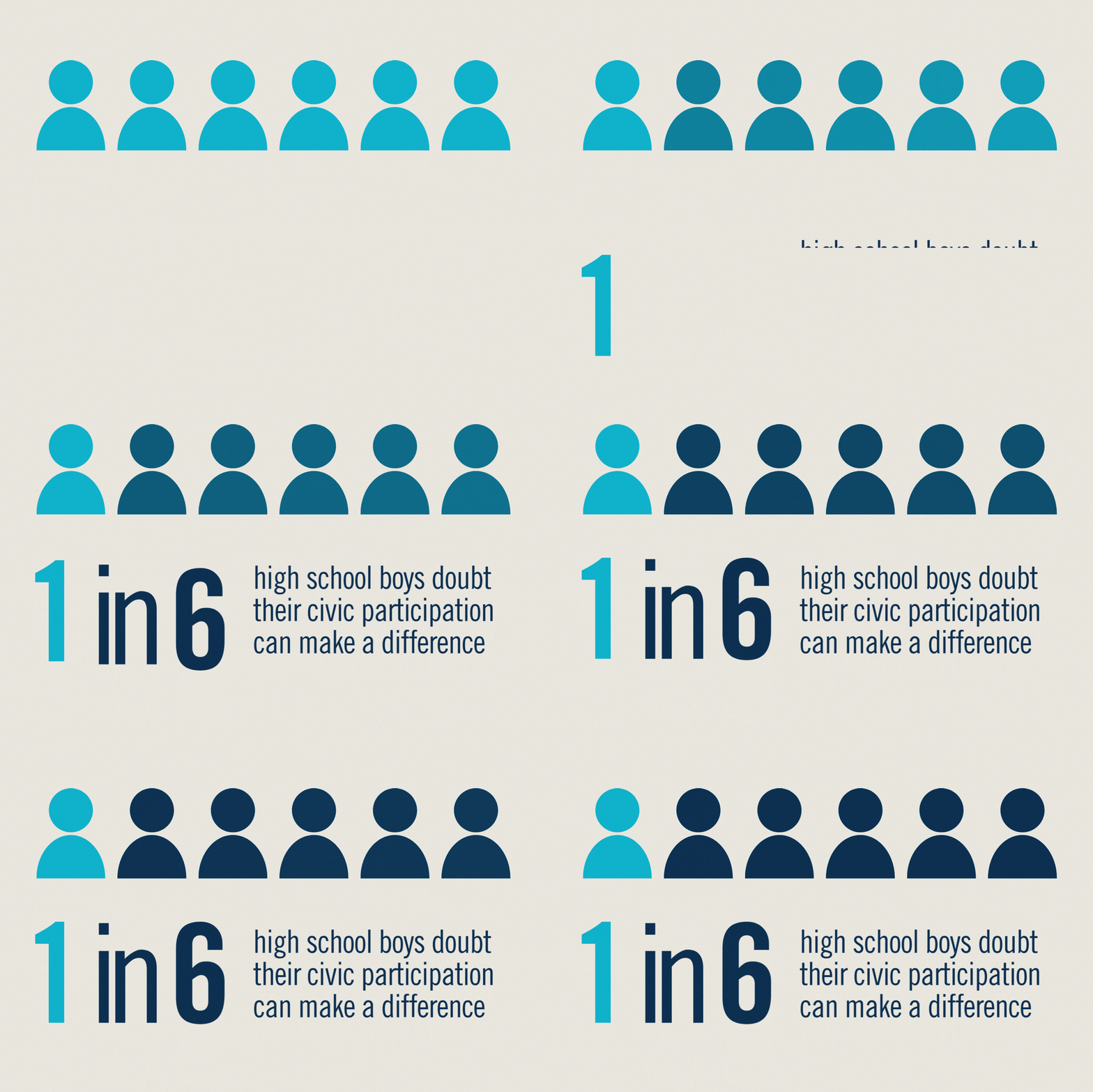
High school boys are most likely to doubt their voices can make a difference.
-

Key Finding 5
Belonging determines what students speak up about and whether they speak up at all.
-

Implications for Schools
Guidance for educators seeking to improve youth civic engagement in their school communities.
-
Conclusion
Students are demonstrating their civic instinct. Schools play an important role in shaping the conditions for young people to flourish.
Introduction
Democracy depends on the idea that your voice matters: that you can speak up, be heard, and help shape the world around you. While formal political participation begins at age 18, civic engagement begins much earlier, as young people develop beliefs about whether their voices matter and whether they can influence the people and communities around them.1
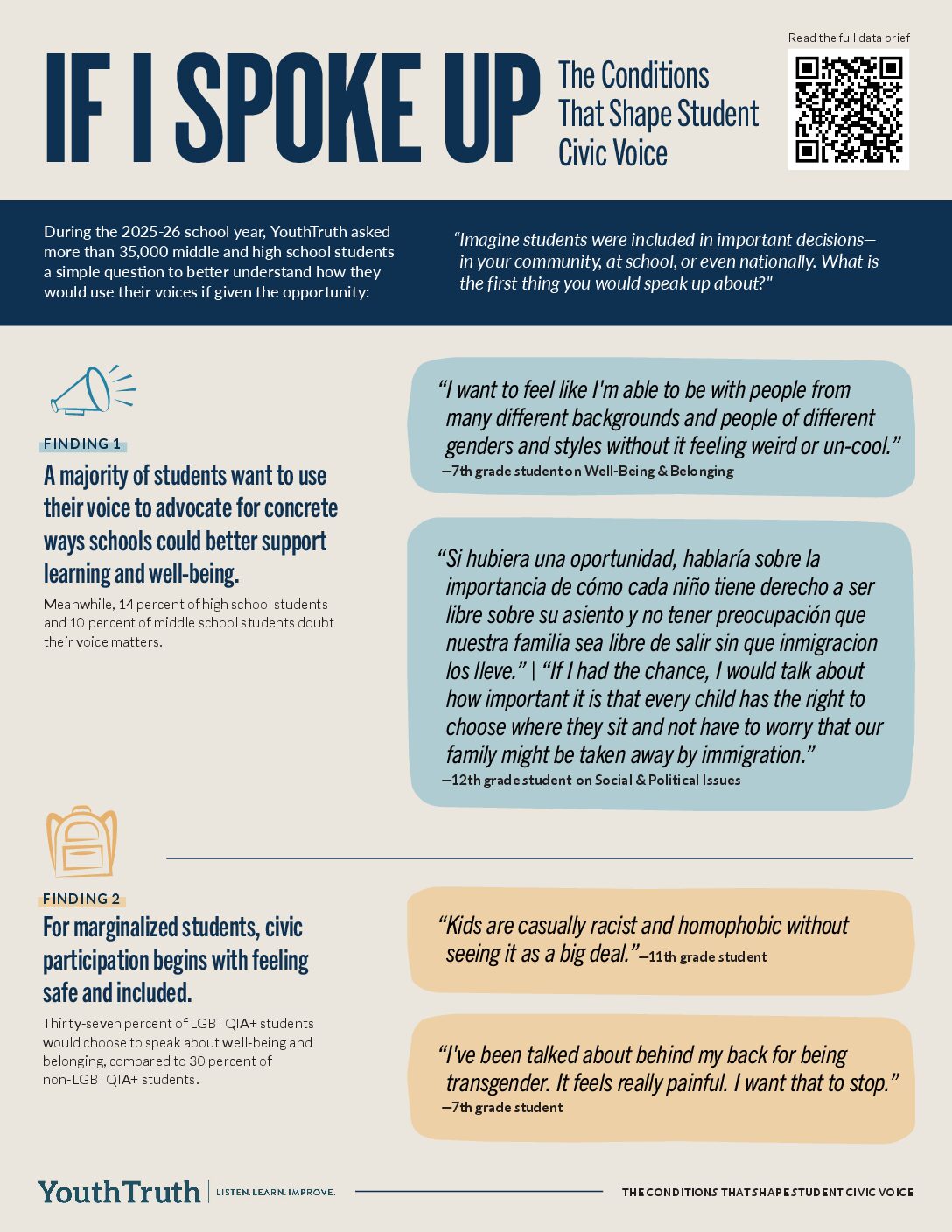
During the 2025-26 school year, we asked more than 35,000 middle and high school students a simple question to better understand how they would use their voices if given the opportunity: “Imagine students were included in important decisions—in your community, at school, or even nationally. What is the first thing you would speak up about?”
Students focused on the immediate realities shaping their daily lives: safety, fairness, belonging, learning conditions, and whether adults listen to them. Their responses show that young people are eager to improve the communities around them. They also reveal that not all students experience the conditions that help them develop the confidence, belonging, and trust needed to participate. Together, these findings offer insights for schools, districts, and communities preparing the next generation for civic life. They also raise an important question: How can schools help students move from imagining they are included in decision-making to actively participating in the decisions that affect their lives?
Finding 1: A majority of students want to use their voice to advocate for concrete ways schools could better support learning and well-being.
Students find school outdated and want learning that actually prepares them for life.
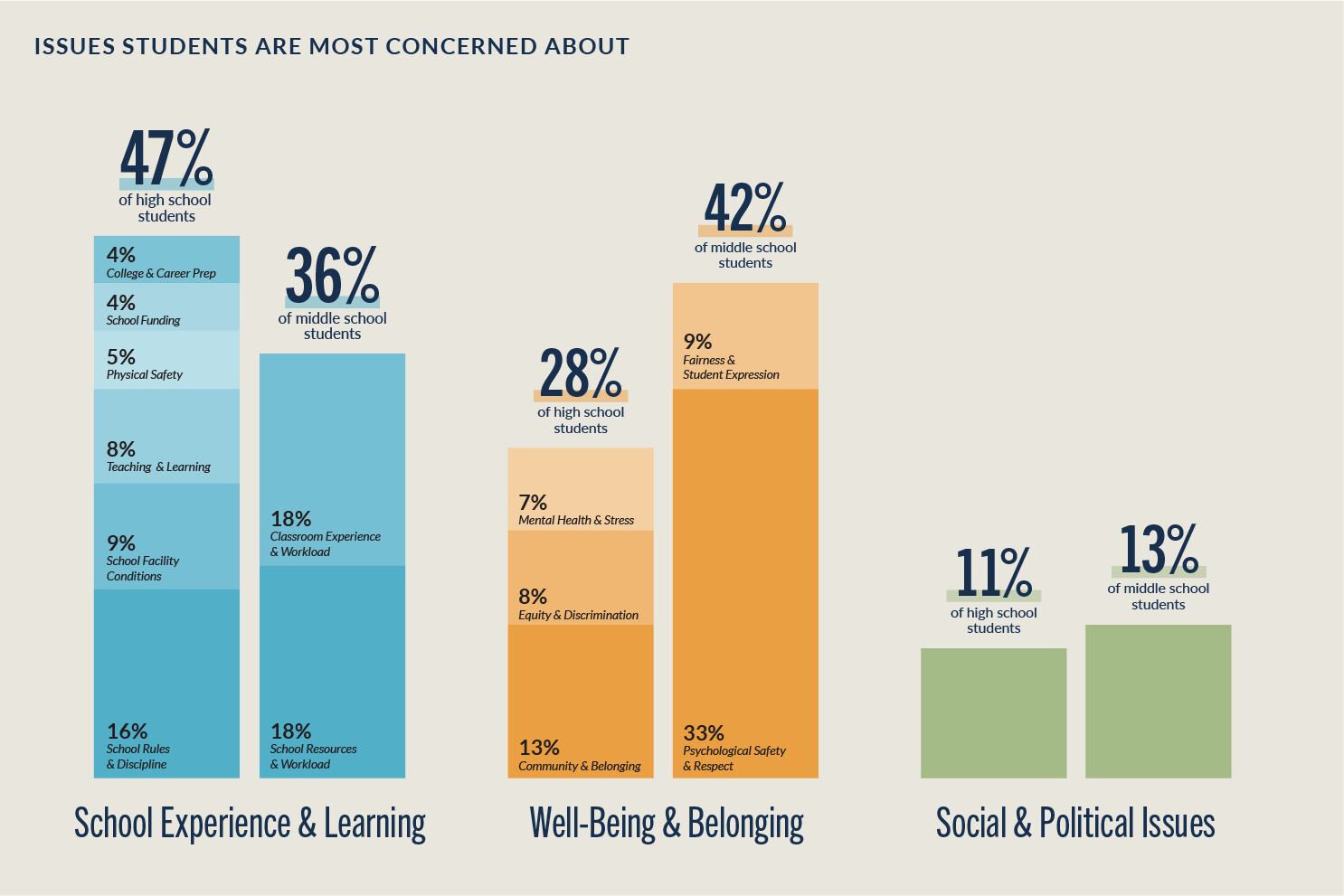
Students shared specific, actionable ideas for how schools could better support learning and well-being. Many questioned whether a school model that has changed little over time is preparing them for a life beyond graduation. One middle school student shared, “Schools have been the same since like the 1700s. They have been teaching the same things [with] no creativity.” Another argued, “Our curriculum doesn’t help us in our everyday life… Everything is about memorization.” Students called for more individualized academic support, engaging and relevant learning experiences such as financial literacy and career preparation, greater flexibility around workload and homework, and support for neurodiverse students and different learning styles.
Students are calling for stronger mental health support.
Mental health was one of the most common well-being concerns students raised. Rather than simply identifying the problem, they proposed concrete solutions. One middle school student called for “more counselors, mental health workshops, and buddy programs” so that students could “feel safe and get help when needed.” High school students more often described feeling overwhelmed as they balanced school, extracurricular activities, and other aspects of adolescence. To reduce burnout, one student argued that “[g]iving students a real voice in setting homework policies, test schedules, and school start times could directly reduce burnout and make learning more effective, not less.” Others called for “more counselors, less pressure with homework, and teachers who actually listen.” Students also urge schools to create safer, more respectful environments by addressing bullying, racism, homophobia and transphobia, sexual harassment, and other forms of exclusion.
Students are paying attention to social and political issues.
Some students used the opportunity to speak up about broader issues affecting their communities and the world, including immigration, climate change, poverty and homelessness, human rights, racism, and the economy. One student wanted to address “issues affecting people who are not around us, such as genocides and famines around the world,” explaining that “it is important to speak up on problems and global evil regardless of whether they affect us or not.” Another focused closer to home, calling for action on climate change because “we can do things in our communities and beyond to help.”
Students identified a lack of voice.
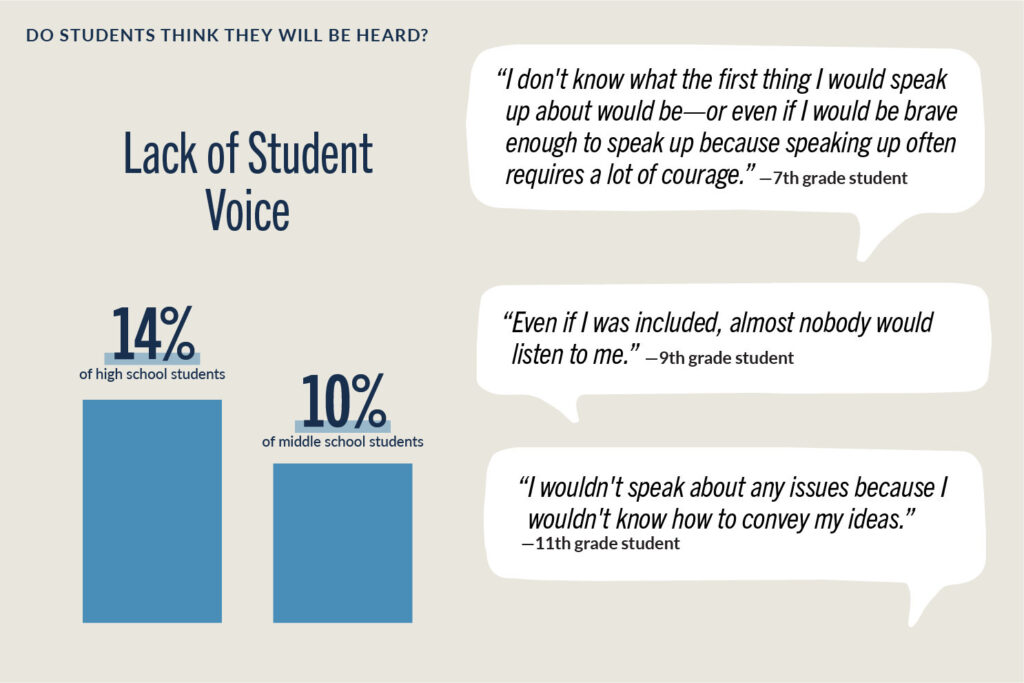
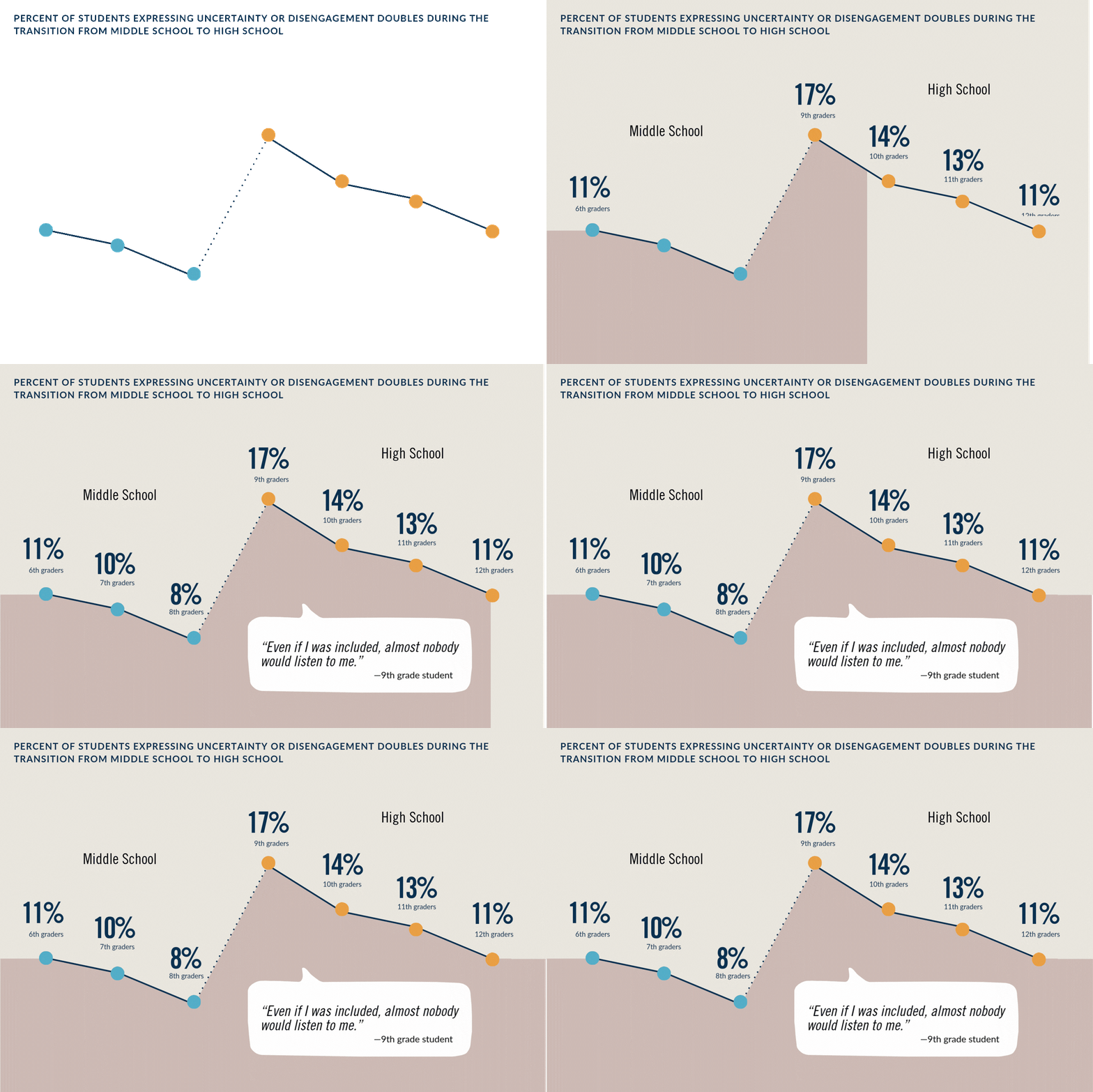
While many students proposed solutions to specific issues, others expressed a broader sense that their voices were unheard or that they were unsure about speaking up at all. How students described this lack of student voice differed across grade levels. Middle school students were more likely to describe uncertainty, hesitancy, or shyness about speaking up, suggesting they were still developing the confidence to use their voices. While high school students, more often questioned whether speaking up would lead to meaningful change or whether adults would listen at all.
Together, these responses show that students are already thinking like civic actors. This finding aligns with emerging conceptions of civic learning that emphasize giving students opportunities to practice civic participation through authentic problem-solving and engagement with issues that affect their communities.2 Instead of focusing on broad issues beyond their reach, they used their imagined access to decision-making to identify problems, propose solutions, and improve the institutions they interact with every day.3 Schools, districts, and policymakers can build on these instincts by creating meaningful opportunities for students to participate in decisions that affect their daily lives.
School Experiences
“Schools have been the same since like the 1700s. They have been teaching the same things [with] no creativity.” —7th grade student
Well-Being & Belonging
“I want to feel like I’m able to be with people from many different backgrounds and people of different genders and styles without it feeling weird or un-cool.” —7th grade student
Social & Political Issues
“Si hubiera una oportunidad, hablaría sobre la importancia de cómo cada niño tiene derecho a ser libre sobre su asiento y no tener preocupación que nuestra familia sea libre de salir sin que inmigracion los lleve.” | “If I had the chance, I would talk about how important it is that every child has the right to choose where they sit and not have to worry that our family might be taken away by immigration.” —12th grade student
Finding 2: For marginalized students, civic participation begins with feeling safe and included.
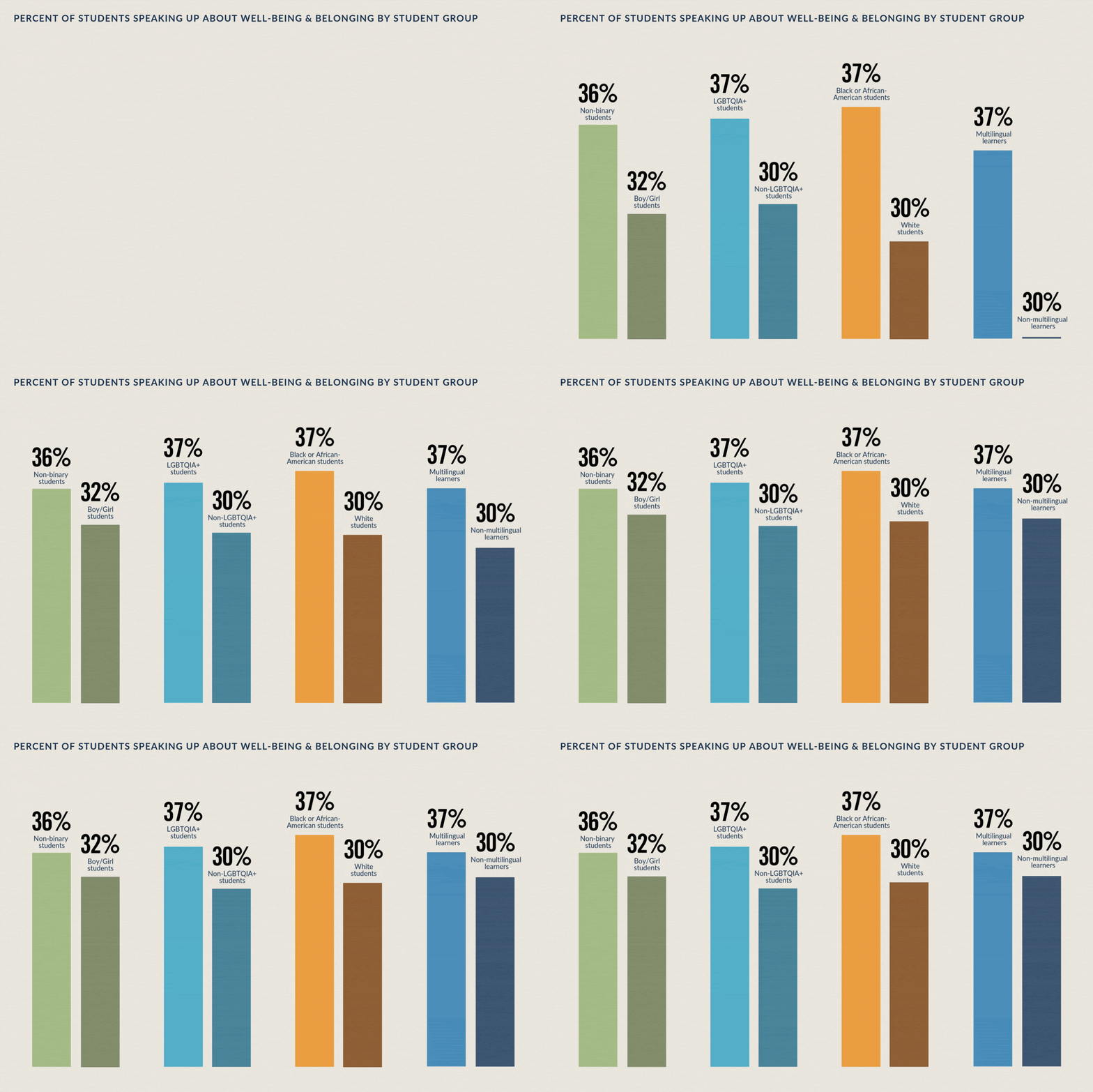
Students from historically marginalized groups were more likely than their peers to focus on inclusion, safety, and well-being. Beyond describing problems, many proposed solutions, including teaching students about LGBTQIA+ identities and experiences, expanding mental health supports, and fostering school cultures built on respect and acceptance. One non-binary middle school student wanted their school to “teach about pride” and “ask [students] for their pronouns so they feel welcomed.” A high school student who identifies as part of the LGBTQIA+ community emphasized the importance of “overall respect,” explaining that “respecting each other’s beliefs, backgrounds, and even personality helps build stronger communities and safe spaces to communicate.”
A high school student who identifies as a Multilingual Learner (MLL) described their school as “very divided” and said that “not everyone feels welcome.” Yet rather than disengaging, the student proposed a path forward: “Make people in our school community feel comfortable to reach out to and talk to people that are not only the same race or family income levels.” Similarly, a middle school student said that “everyone [should] feel safe, heard, and treat[ed] equally no matter their background, race, or beliefs.”
These responses show students using their civic voice to identify the conditions that shape whether they feel safe, respected, and valued in school. Although schools should be places where every student feels welcome, these responses suggest that this is not the case, especially for students with certain identities. It is difficult to ask students to imagine participating in broader civic life when they do not yet feel heard, safe, or included in the communities closest to them.
For non-binary students, LGBTQIA+ students, MLLs, and students of color, feeling safe, respected, and included is the foundation for civic participation. Their civic voice often begins with advocating for the conditions needed to fully participate in school life: safety, respect, belonging, and trust. Schools have an opportunity to narrow the civic empowerment gap by creating environments where students see their identities affirmed, their concerns taken seriously, and their voices leading to meaningful change.
“Kids are casually racist and homophobic without seeing it as a big deal.” —11th grade student
“I’ve been talked about behind my back for being transgender. It feels really painful. I want that to stop.” —7th grade student
“It is extremely important to me to see students have a safe space to express their gender and sexuality without being ridiculed by others, including family.” —12th grade student
Finding 3: Middle school is a critical time for developing the confidence to speak up.
Middle school is a critical period for developing civic voice and agency. Many younger students are still forming opinions, building confidence, and learning how to participate in decisions that affect them. During this time, they also begin developing beliefs about whether their voices matter and whether they can influence the world around them.
Students’ responses reflect this developmental stage. Many middle school students described hesitating to speak up because they were shy, uncertain, or lacked confidence in their own knowledge. One student explained, “I’m not social enough to speak about literally anything. I would avoid it completely and probably wouldn’t speak up [about] anything since I’m not brave enough.” Another worried, “If I spoke up, I’d probably say the wrong thing. I don’t think I’m anywhere near as knowledgeable as any of the other people making the decision.” A third simply stated, “I am personally too shy and [it] would be a very big surprise if I spoke up.”
Other students expressed skepticism that adults value student perspectives at all. Some remarked that “No adults really care about what students say…” while others believed speaking up would be futile because “no one would support me.” These responses show that middle school students are not only developing their own sense of voice, but also forming beliefs about whether the adults and institutions around them are willing to listen.
Because these beliefs are still taking shape, middle school offers an important opportunity to build students’ confidence and civic agency. Students who hesitate because they are still building confidence may benefit from opportunities to practice speaking up, sharing ideas, and participating in decisions. Students who already believe their voices do not matter may need different experiences that show adults are listening and that student perspectives can lead to change. Without those experiences, uncertainty can harden into disengagement.
“I get scared talking about important things and often get embarrassed when I try, so I wouldn’t say anything.” —7th grade student
“No adults really care about what the students say. They probably will just have us ‘speak up’ and fix minor, irrelevant issues to make us feel like we made a difference.” —Middle school student
“There are too many problems to deal with but I assume that others would single out the important ones.” —6th grade student
Finding 4: High school boys are most likely to doubt their voices can make a difference.
By high school, some students begin to question whether their voices matter at all. Boys were consistently more likely than girls to express disengagement, pointing to important differences in how students experience connection, participation, and agency at school.
Many boys questioned whether their voices matter, whether adults would listen, and whether they could influence decisions affecting their communities. While some expressed indifference toward participation, many others doubted that speaking up would lead to meaningful change or viewed themselves as observers rather than participants. One student remarked, “I don’t think that anything any student says ever is actually addressed.” Others questioned whether they had anything meaningful to contribute: “I’d leave that to other people who have better ideas than me.” Another student admitted, “I honestly don’t see making change myself as a possibility.” These responses show that disengagement is not always rooted in civic apathy. Instead, it often reflects doubts about whether students’ voices matter, whether they belong in decision-making spaces, or whether they have the ability to make a difference.
This pattern matters because student voice helps shape civic engagement later in life. Research shows that students who recall having meaningful opportunities to develop their voice in high school are twice as likely to vote and participate in civic life as adults compared to those who do not recall having the same experiences.4 When students believe that their perspectives are unlikely to influence decisions, they miss opportunities to develop the confidence and sense of agency that support lifelong civic participation.
“Even if I was included, almost nobody would listen to me.” —9th grade student
“I wouldn’t speak about any issues because I wouldn’t know how to convey my ideas.” —11th grade student
“I definitely do not care enough to speak up about anything.” —10th grade student
Finding 5: Belonging determines what students speak up about – and whether they speak at all.
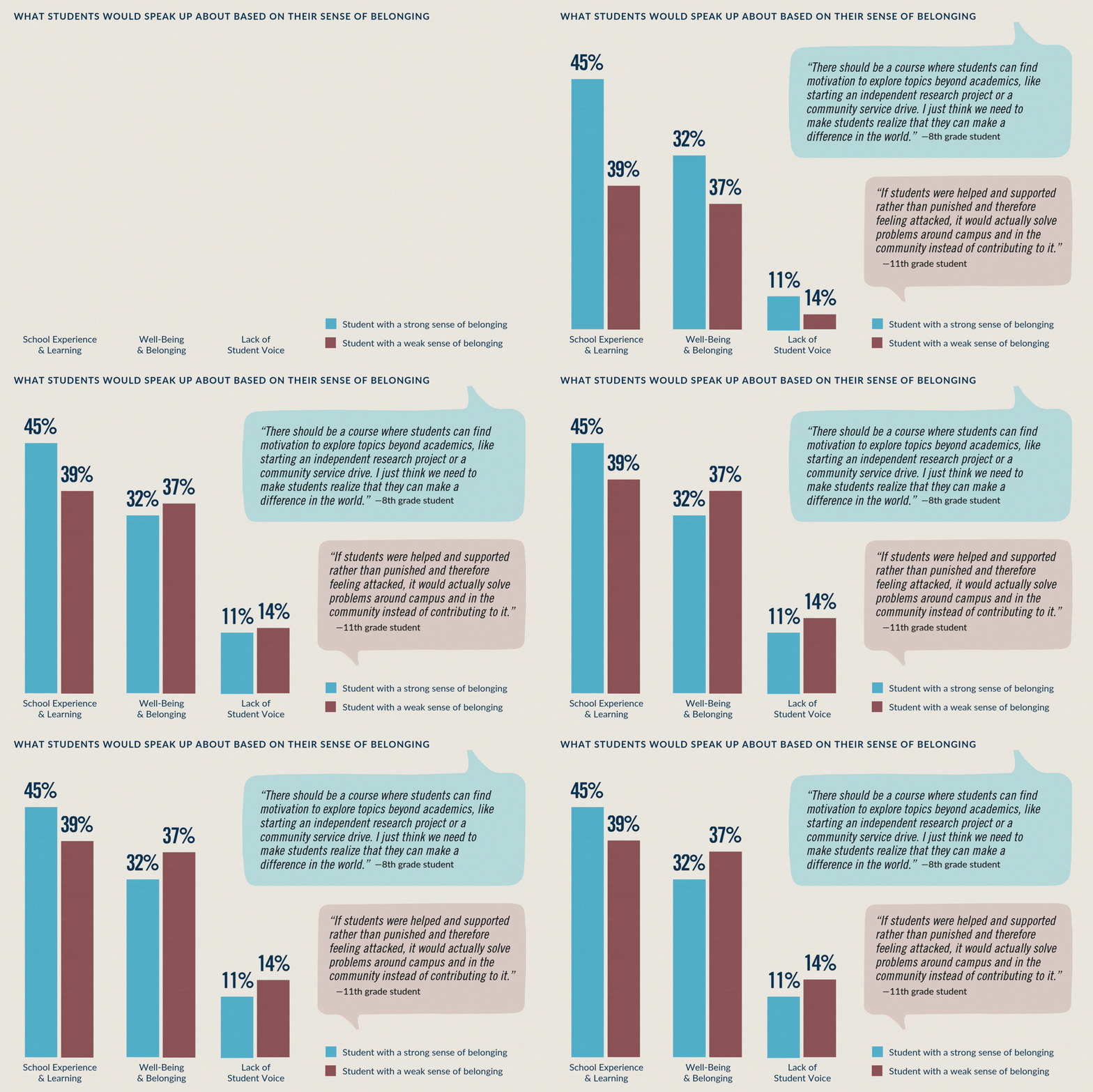
Belonging is the thread connecting how students think about participation and voice. Students who feel connected to their school community are more likely to focus on improving a community they already feel part of, while students who feel disconnected are more likely to focus on gaining access to that community in the first place. These findings show that belonging shapes not only whether students participate, but also what they believe is worth speaking up about.
Students with a strong sense of belonging often expressed greater confidence in using their voices to improve their schools. One middle school student called for more learning connected to current events, arguing that schools should “educate us about stuff that is happening in the world.” High school students expressed similar desires for participation, calling for “creating student advisory boards where [students] provide feedback” and “welcoming students to make important decisions.”
Students with a weaker sense of belonging focused more often on the conditions preventing them from feeling connected in the first place. One middle school student who did not feel connected to their school community said, “The first thing I would talk about is that school should work on actually helping [students] with their problems. Schools should learn about students’ lives.” Similarly, high school students who lacked a sense of belonging wanted to speak up about “the connections students have to their school and to their peers and how to improve them.”
Students who felt less connected to school were also more likely to express disengagement or uncertainty about participation. Across both middle and high school, students who did not feel connected to their school community were more likely to express civic disengagement. Together, these findings show that belonging helps explain not only whether students participate, but also what they believe is worth speaking up about.
Across the previous findings, belonging consistently emerges as the condition that shapes whether students see themselves as participants, whether they believe adults will listen, and what they choose to speak up about. When students feel they belong, they are more likely to see themselves as active participants with a stake in improving their communities.
“I would advocate for a larger incorporation of AI into schooling. The reality is that we are going to be growing up in a world where AI is a huge part of any career field, and I think it’s important to learn how to use AI as a tool, rather than a cheat code.” —12th grade student
“I have heard many people my age and even younger getting in trouble for ‘talking back’ or ‘getting an attitude’ when we are in fact just advocating for ourselves.” —7th grade student
“A lot of students struggle with stress, anxiety, and other issues, but sometimes we don’t know who to talk to or how to get help. Having more support and ways to talk about these things would really make a difference and help everyone feel safer and more understood.” —8th grade student
Implications for Schools
Schools play an important role in helping students develop the confidence, trust, and sense of belonging needed to participate in civic life. Across these findings, three broad implications emerge.
1. Belonging comes first.
Across every finding, belonging emerged as a precondition for civic participation, not simply a benefit of it. Students who feel connected to their school community use their voices to improve it. Students who do not are still working to gain access to it. For students from historically marginalized backgrounds, civic engagement cannot begin with opportunities to participate alone. It begins with affirmation: ensuring identities are recognized, concerns are taken seriously, and student voices are treated as assets. Schools that prioritize student voice without first building belonging risk creating opportunities that reach only the students who already feel welcome.
What would need to change in your school for more students to feel safe, respected, and comfortable sharing their ideas?
2. Identify the students least likely to raise their hands.
If opportunities for student voice primarily attract students who already feel connected and empowered, schools risk overlooking the perspectives of those whose experiences may most need attention. Meaningful participation requires more than listening to students who readily speak up. It also requires intentionally reaching students who are disconnected, uncertain, or skeptical that their voices matter. Strengthening belonging creates the foundation for developing civic voice and participation.
Whose perspectives are missing from important decisions at your school, and what would help those students participate?
3. Support hesitant and skeptical students in distinct ways.
Not all students who remain quiet need the same support. Students’ needs change as their beliefs about civic participation develop. In middle school, students are still building the confidence to speak up. By high school, some students have begun to question whether speaking up makes a difference. Schools can help prevent that shift by giving students repeated opportunities to practice using their voices, demonstrating that student feedback leads to visible action, and building confidence before uncertainty becomes skepticism.
What helps students feel confident speaking up in your school, and when have they seen their ideas lead to meaningful change?
Conclusion
Civic engagement begins long before students turn 18 or cast their first vote. It develops as young people form beliefs about whether their voices matter, whether adults will listen, and whether they can influence the people and institutions around them. The students in this study showed that civic instinct is already present. They identified problems, proposed solutions, and revealed the conditions that shape whether that instinct grows or recedes: belonging, trust, representation, and the experience of being heard.
Schools play an important role in shaping those conditions. When students experience belonging, see their identities are affirmed, and know their perspectives lead to action, they begin seeing themselves as active participants in their school and communities. Preparing students for civic life begins by showing them that their voices matter today.
References:
- Tyler, M., & Iyengar, S. (2022). Learning to Dislike Your Opponents: Political Socialization in the Era of Polarization. American Political Science Review. https://doi.org/10.1017/S000305542200048X ↩︎
- Sims, M., Chu, L., Keskin, A. K., Rainey, L., & Diliberti, M. K. (2025). What counts as civics? A look at how districts define and facilitate civic learning. Center on Reinventing Public Education. ↩︎
- To learn more about the qualitative codebook, click here. ↩︎
- Siegel-Stechler, K., Price, N., & Medina, A. (2024). Youth who develop their voice in high school are more likely to vote. Circle at Tufts. https://circle.tufts.edu/latest-research/youth-who-develop-their-voice-high-school-are-more-likely-vote
↩︎