Research Report
The Civic Gap: How Schools Can Cultivate Student Voice and Participation
Overview
Only 1 in 3 middle and high school students report strong opportunities for civic participation at school. What can educators and policymakers do to foster more engagement?
Drawing on responses from nearly 140,000 middle and high school students and 10,000 teachers, this report identifies the conditions that make it possible for young people to develop the skills democracy will require of them.
Read further for the full report, or download it here.
-


Introduction
Learning about civic life is much different than having opportunities to practice it.
-


Key Finding 1
Students report fewer opportunities for civic participation than teachers assume they have.
-

Key Finding 2
Belonging and trust are drivers of civic participation at school.
-

Key Finding 3
Instruction that challenges students and connects to their lives is linked to stronger civic participation.
-

Implications
How educators and policymakers can cultivate schools that foster strong youth civic participation.
-
Conclusion
Students are demonstrating their civic instinct. Schools play an important role in shaping the conditions for young people to flourish.
Introduction
Civic engagement is how people shape the communities and societies they want to live in. It is how we advocate for what matters to us, work across differences, hold institutions accountable, and contribute to decisions that affect our lives. For young people, becoming civic participants means developing the confidence and skills to speak up, working with others, and believing that their participation can make a difference. These capacities are essential to a functioning democracy, but they do not develop automatically.
Civic education has long been part of the role schools play in preparing young people for the future. Across the country, states have embedded civics into standards, graduation requirements, and social studies curricula. As of 2025, 36 states require a civics course in high school to graduate, while only five require one in middle school. Twenty-nine states require a civics assessment, 17 recognize excellence in civics among students or schools, and 39 provide credit for service-learning opportunities.1 These policies reflect deeply held values about schools’ responsibility to prepare young people to become informed and engaged members of their communities and society.
But learning about civic life is much different from having opportunities to practice it.
District leaders tell an important part of the story: 90% say their schools teach civics, but only 13% say their schools require experiential civic learning.2 In this report, students offer another perspective by showing whether those opportunities are part of their day-to-day school experience. YouthTruth’s 2024 Youth Civic Empowerment report revealed a disparity between students’ desire to contribute and their confidence and ability to do so. More than half of students said helping others was important to them, yet only 44% felt empowered to make a difference and just 30% reported taking meaningful action to change something for the better in their school, community, or the world. These findings raised an important question: Where are young people supposed to develop confidence and skills to participate if they do not have opportunities to practice those skills? This report calls the space between teaching civic life and creating chances to practice it, the civic gap.
Schools are uniquely positioned to provide that practice. Young people spend much of their time in school where they are already experiencing the core tenets of democracy: navigating communities, interacting with people who are different from them, following and questioning rules, joining groups, working with adults, and making decisions that affect their lives. In this way, schools are not only places where students can learn about civic life. They can also be places where students experience it.
This report examines whether secondary students and educators experience their schools as places that foster civic participation, and what aspects of school culture and systems support or hinder that experience. To do so, the schools as civic spaces framework looks at three interconnected parts of students’ everyday experiences:
- Civic climate is whether schools create an environment where participation is possible. Students were asked to share their experiences with having real influence on how things are run and whether their school creates opportunities to discuss important topics, even when people disagree.
- Civic practice is whether students have opportunities to put participation into action. Students were asked to share their perspectives on working with adults to make changes in school and learning how to take action through civic and political systems.
- Civic joining is how students come together and build community. Students were asked about opportunities to spend time with different peers and what motivates them to participate in clubs, sports, and other activities.
Together, these three dimensions offer a way to understand whether schools are giving students meaningful opportunities to experience civic life through their everyday interactions, learning, and participation.
Drawing on the voices of nearly 140,000 middle and high school students and 10,000 teachers during the 2025-26 school year, this report explored two central questions:
- Do students and teachers experience their schools as places that foster civic participation?
- What conditions make that more or less likely?
What was found confirms the civic gap: a difference between teaching students about civic life and creating a school where they can experience it. Students need opportunities not only to learn about participation, but to have a meaningful voice, engage with people across differences, work with others to make change, and see that their contribution matters.
The first finding shows the civic gap in numbers: students report far fewer opportunities for civic participation than their teachers assume they have. The next two point to what schools can actually build: belonging and trust are foundational for civic participation at school, and instruction that challenges students and connects to their lives is linked to stronger civic participation. Both are stronger drivers of civic participation than a school’s location or size.
Finding 1: Students report fewer opportunities for civic participation than teachers assume they have.
I hope that students’ participation is not just about expressing opinions, but a process of truly influencing decision-making, understanding public affairs, and learning democratic practices.
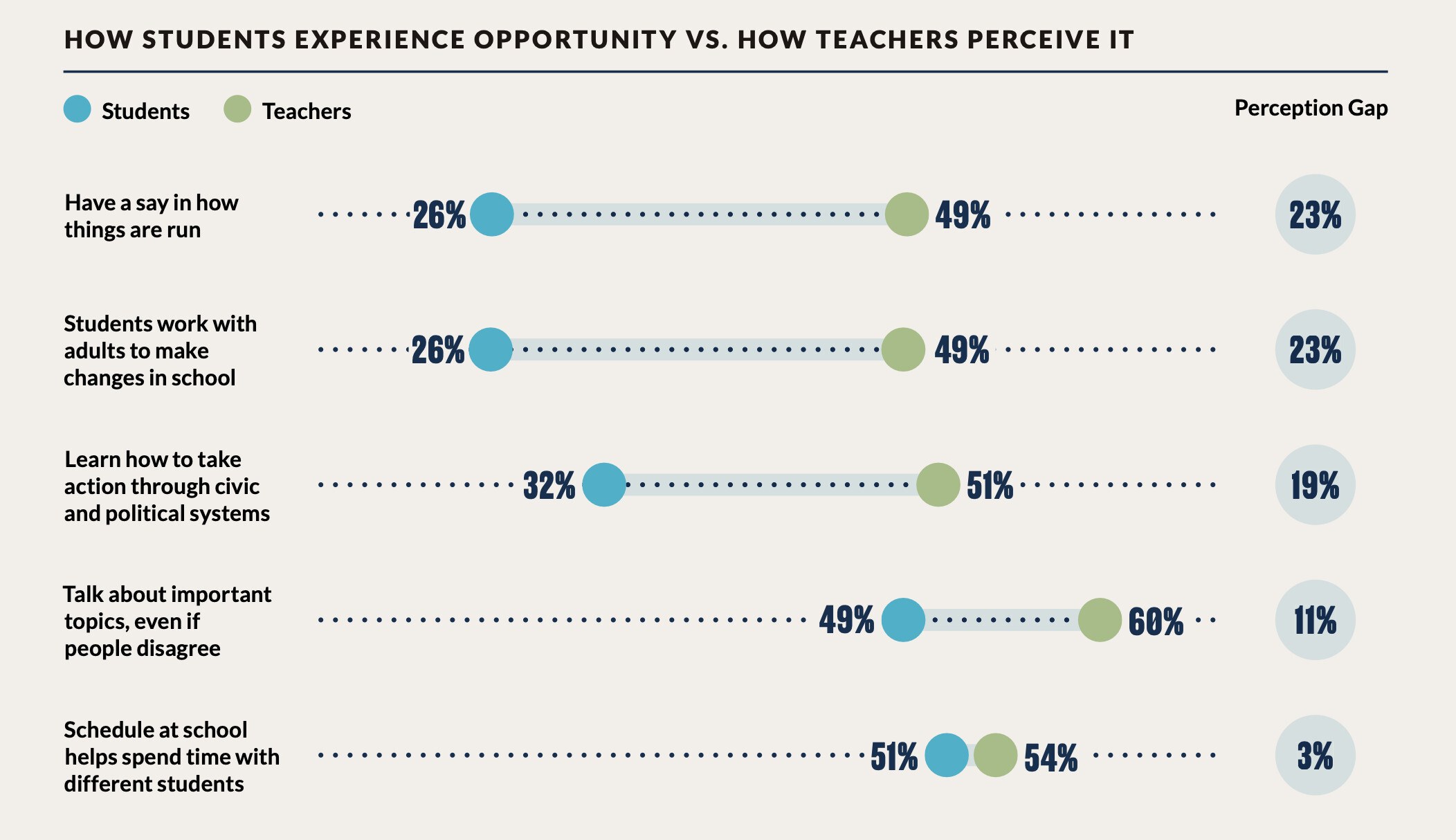
Only about one in three students report strong opportunities for civic participation at school, while more than half of their teachers do. Students report experiencing elements of a strong civic climate, such as discussing important issues and connecting with peers outside their typical groups. Fewer report opportunities for civic practice, including having a voice in school decisions, working with adults to make change, and learning how to take action through civic and political systems.
Where the Perception Gap is Widest. Teachers perceive more opportunities for student participation than students report across all items. Teachers are 19% more likely than students to rate their schools positively across these civic experiences. The gap is particularly large for civic practice. Only 26% of students say they have a say in how things are run at school, compared with 49% of teachers who believe students have that opportunity. A similarly large gap appears around opportunities to work with adults to make changes at school.
[Teachers] often make decisions that can greatly impact students without consulting them first or acknowledging their opinion, preferences, and/or needs.
Why the Perception Gap Matters. If adults believe opportunities for civic practice already exist, they may not recognize where those experiences fall short for students. A school can have student councils, leadership programs, government classes, and advisory committees and conclude that students have opportunities for voice. But those structures matter only if students experience them as accessible and consequential.
I feel as though our opinions are not even taken into consideration and that many people of ‘authority’ are extremely unfair and even on a power trip.
The question for schools is not simply whether opportunities for participation exist, but whether students know about them, can access them, and believe their participation can influence what happens. Creating opportunities for student voice is only part of the equation; how adults share power and respond to student perspectives helps determine whether those opportunities feel meaningful.
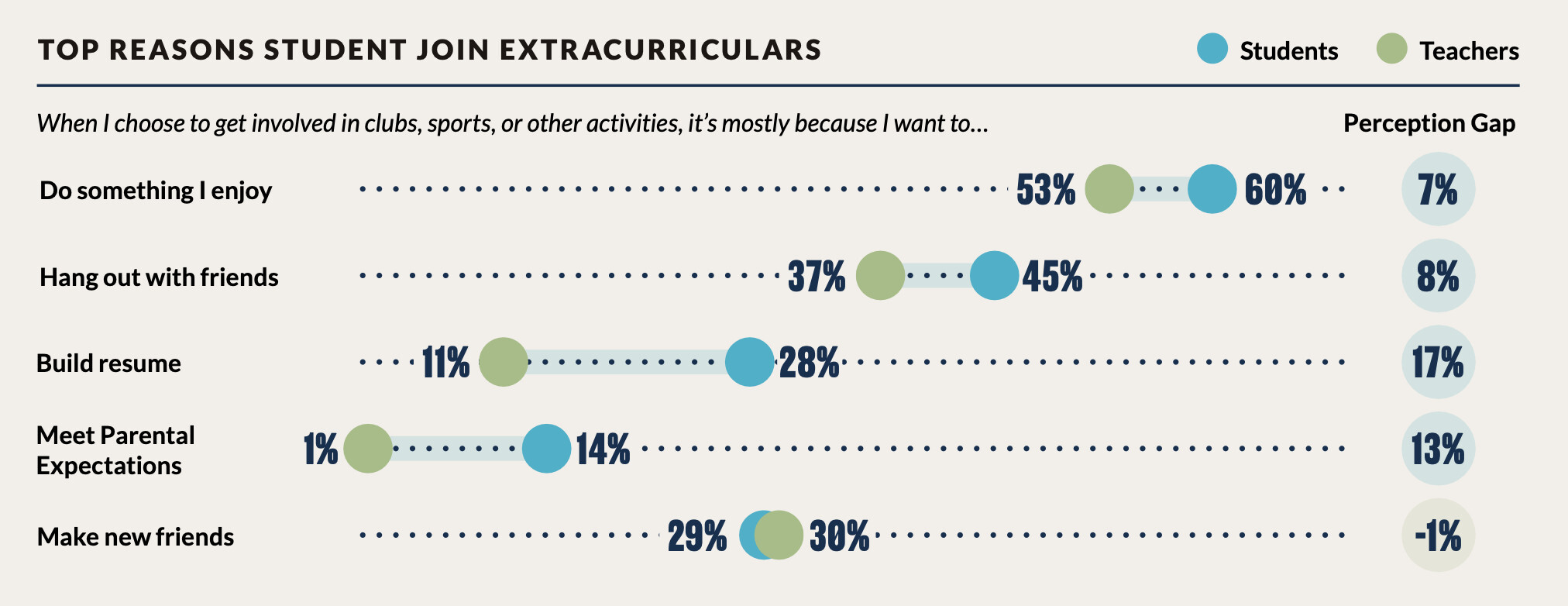
Rethinking Why Students Join. The perception gap extends to why students participate in the first place, part of civic joining: how students come together and build community through groups and shared activities. Students say they join clubs, sports, and other activities mostly to do something they enjoy (60%) or spend time with friends (45%). Teachers see a more civic motive: 31% believe students join to be part of something bigger than themselves, compared with 15% of students, and 21% believe students participate to lead, speak up, or take action, compared with 9%.
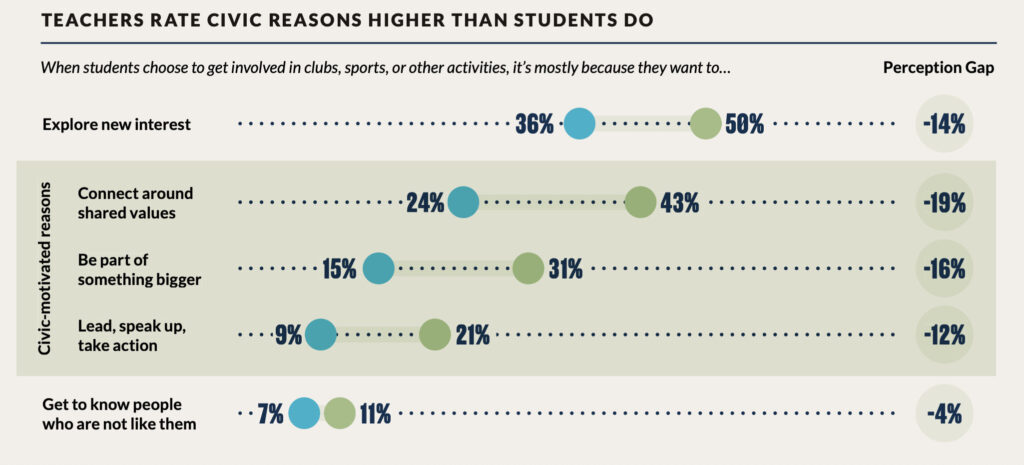
These differences don’t mean students’ reasons are less valuable; they raise questions about the assumptions adults make about what draws students into groups. One eighth grader described how joining band led to an unexpected friendship: “In band, I was able to connect with a classmate I otherwise thought I wouldn’t make a connection with… I learned that extracurricular activities outside of school can help bring people together.” Schools can build from motivations like these by creating opportunities for students to form relationships, encounter people outside their usual circles, and gradually take on greater responsibility.
Key Takeaway:
Adults and students do not always see civic life at school in the same way. Understanding students’ perspectives, including what motivates them to participate, is essential to understanding whether schools function as places where students can meaningfully practice civic participation.
Finding 2: Belonging and trust are foundations for civic participation at school.
I like hanging out with friends and seeing some of my teachers because they make me feel like I belong.
Students are more likely to experience school as a place for civic participation when they also experience a strong sense of belonging. Belonging here means more than feeling socially connected: it includes whether students feel part of their school community, whether adults treat them and students from different backgrounds with respect, and whether teachers and discipline are fair. That trust matters for civic participation because having a voice requires believing that speaking up is safe and that adults and school systems will respond fairly.
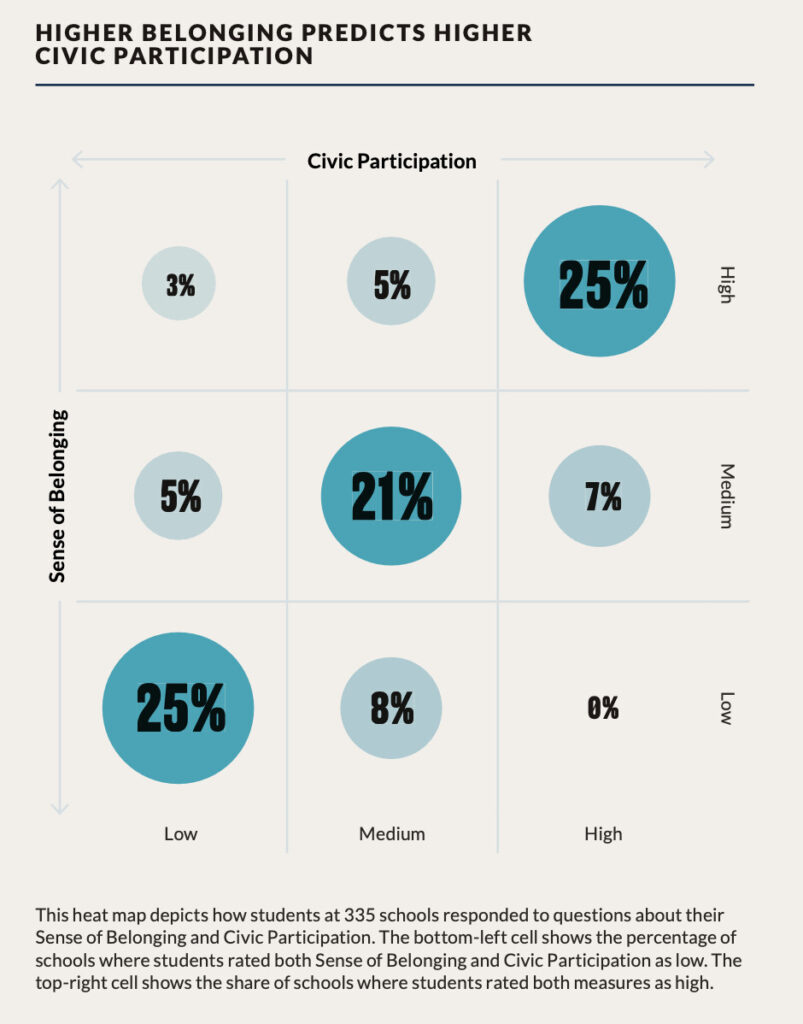
Across schools, belonging and civic participation move together: where students report a stronger sense of belonging, they also report more voice in how school is run, more opportunities to discuss important issues, and more opportunities to work with others and take action.
Trust in Adults vs. Trust in the System. Looking more closely at the experiences that make up school belonging helps explain what may be driving this relationship. Students were asked about both their interactions with adults and their experience of the school community and its systems. Their responses reveal an important distinction: students are more likely to feel respected by adults around them than to feel a strong sense of belonging to the school or trust that its systems are fair.
Students are most likely to say that adults respect students from different cultural backgrounds (72%) and treat students with respect (60%), but far fewer feel like part of their school community (45%) or believe school discipline is fair (42%). In other words, positive relationships with individual adults do not necessarily translate into trust in the school as an institution. Students may experience respectful interactions with teachers while still questioning whether they belong, whether rules are applied fairly, or whether the systems governing school life work for them.
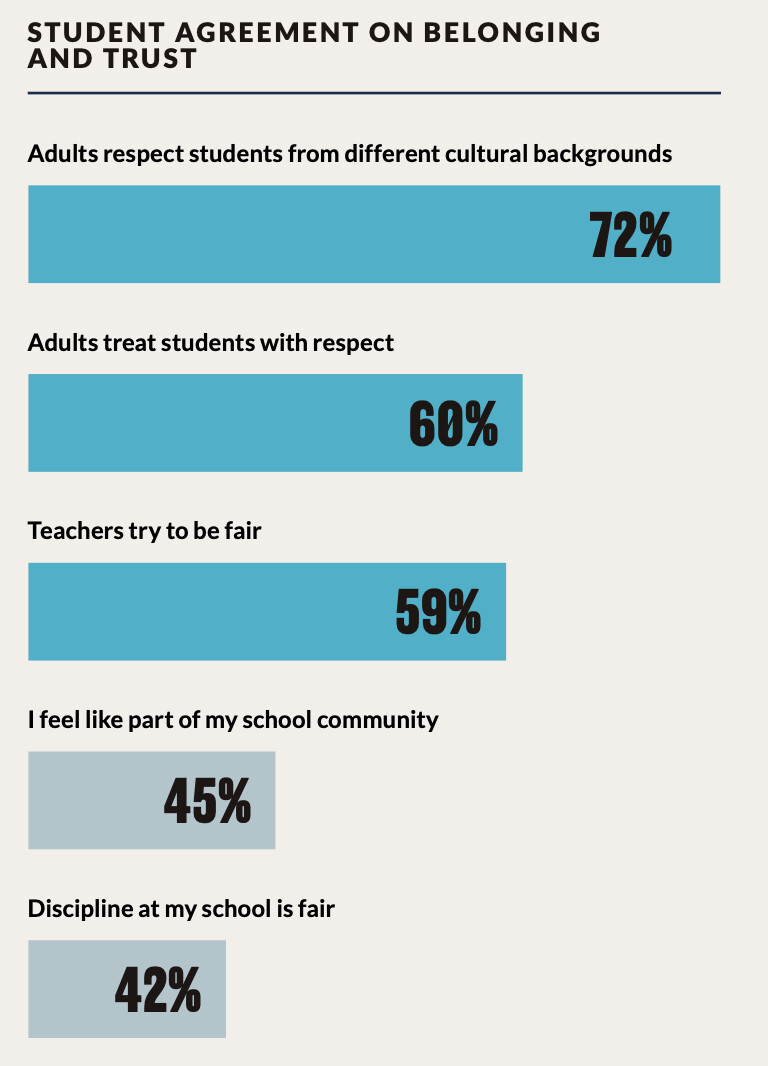
That distinction is especially important for civic participation. Having a meaningful voice requires more than a positive relationship with an individual teacher; it also requires some trust that the larger institution will listen and respond fairly. A student who feels respected but does not believe school systems are fair may be less likely to engage in opportunities to speak up, work with adults, or try to influence a decision.
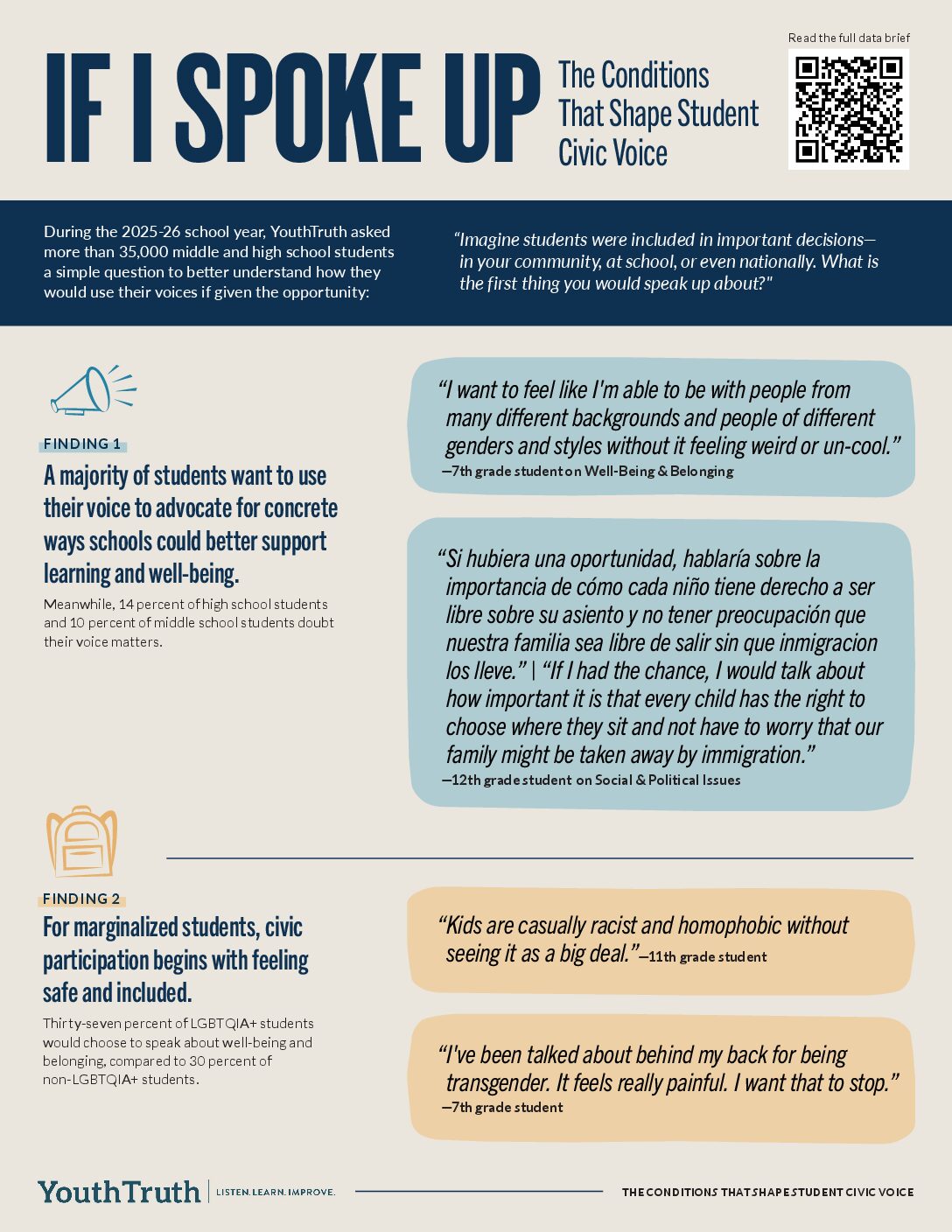
If I Spoke Up, a companion brief drawing on students’ own words from this same survey, found that most students are willing to speak up about issues affecting their learning, well-being, schools, and communities. But students who feel less connected to their schools are also more likely to question whether speaking up will make a difference. Having something to say and believing there is a meaningful opportunity to say it are not the same thing. Feeling part of the community and trusting its systems are fair may help students believe their participation will be taken seriously.
These responses show students using their civic voice to identify the conditions that shape whether they feel safe, respected, and valued in school. Although schools should be places where every student feels welcome, these responses suggest that this is not the case, especially for students with certain identities. It is difficult to ask students to imagine participating in broader civic life when they do not yet feel heard, safe, or included in the communities closest to them.
For non-binary students, LGBTQIA+ students, MLLs, and students of color, feeling safe, respected, and included is the foundation for civic participation. Their civic voice often begins with advocating for the conditions needed to fully participate in school life: safety, respect, belonging, and trust. Schools have an opportunity to narrow the civic empowerment gap by creating environments where students see their identities affirmed, their concerns taken seriously, and their voices leading to meaningful change.
When Inclusion is Explicit. Additional questions, asked in a subset of 119 schools, explored this connection further. Students in these schools were asked whether their school encourages them to speak out against racism, encourages them to get to know people of diverse backgrounds, and clearly communicates how to report discrimination. Schools where students responded more positively to these practices also had students who reported stronger opportunities for civic participation. These questions were asked in only a subset of schools, but the pattern suggests belonging is not created simply by making students feel welcome. It is also shaped by what schools do when questions of fairness, difference, and discrimination arise.
Key Takeaway:
Belonging is not just about students feeling welcomed by the adults around them. It also depends on whether they trust the systems that govern school life, including discipline, fairness, and how concerns get handled, to treat them fairly. Schools that build broader trust, not just positive individual relationships, give students the foundation they need to see speaking up, working with adults, and trying to make change as safe and worthwhile.
Read more: Students in large-city schools and schools with lower enrollment report stronger opportunities for civic participation.
Finding 3: Instruction that challenges students and connects to their lives is linked to stronger civic participation.
My history teacher makes me feel seen and always gives me extra explanations when I ask for help. He helps me feel more confident and excited for the future.
Civic development isn’t confined to civics class. Across subjects, classrooms can give students opportunities to think critically, wrestle with complex ideas, and build relationships with adults who take their learning seriously. To explore this, students were asked whether their schoolwork makes them really think, whether teachers care if they are really learning, and whether teachers understand their lives outside of school, capturing both whether students feel challenged and whether they feel known.
Across schools, these experiences are closely connected to civic participation: where students feel more challenged, known, and supported, they also report more voice in school decisions, more opportunities to discuss important issues, and more opportunities to work with adults and take action. Classrooms, in other words, can be an everyday place to practice the habits civic participation requires.
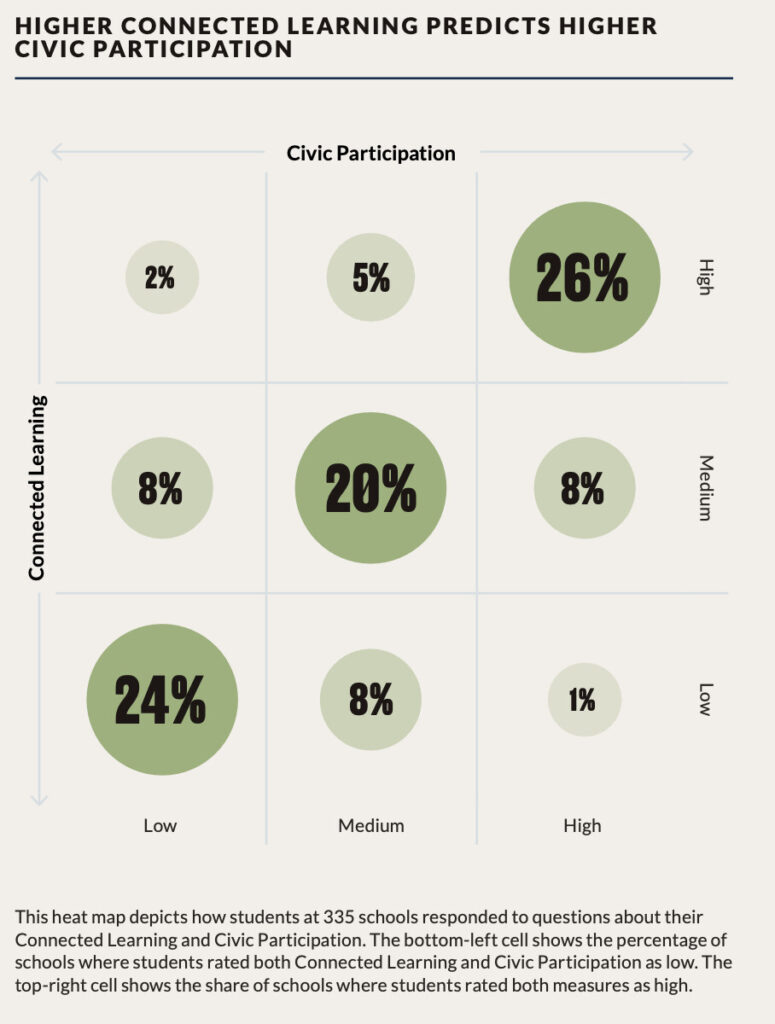
Challenged, But Not Known. Looking more closely at students’ responses, however, reveals a notable gap between being challenged academically and feeling personally known by teachers.
More than half of students (55%) say their schoolwork makes them really think. Far fewer say their teacher cares whether they are really learning (29%), and just 22% say their teacher understands their life outside school. Students, in other words, experience intellectual challenge much more often than they experience the relationships that help connect learning to who they are and the lives they lead.
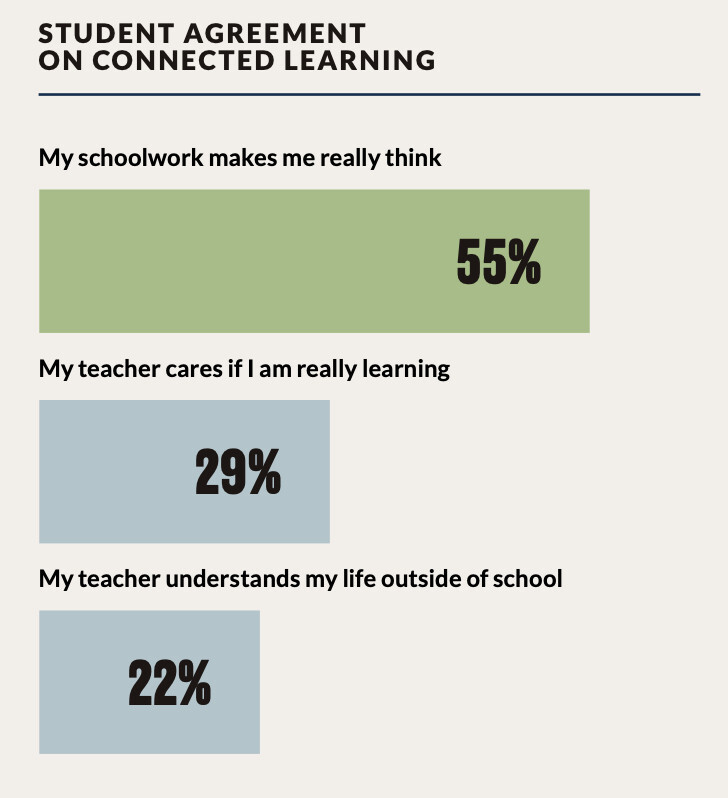
Connected learning happens when students link what they learn to their own interests, relationships, and life outside the classroom, not just to the single lesson or subject in front of them. Students’ own words illustrate why that connection matters. One sixth grader described feeling comfortable asking for help because “my teachers all understand me and my life outside of school.” A seventh grader described a different way learning can extend beyond the classroom: “They make me think about the deeper meaning of what we are learning about. For example, in ELA we learn about things that actually have a deep meaning that connects to life.” These reflections show two sides of connected learning: being known by the adults teaching them and being asked to connect what they learn to a world beyond the classroom.
Key Takeaway:
Connected learning alone does not turn every classroom into a civics classroom. Rather, it shows how civic development can be part of students’ everyday learning. When students are challenged to think deeply, connect ideas to their lives, and develop relationships with adults who value their learning, school becomes a place where they practice the habits participation requires: thinking critically, considering different perspectives, communicating their ideas, and seeing themselves as people whose contributions matter.
Together, these two conditions, belonging and connected learning, matter more to civic participation than where a school is located or how big it is. How students feel about belonging and connected learning predicts how they feel about their schools as civic spaces. Unlike location or size, they are also experiences every school can work to build.
Implications
Building stronger civic participation requires more than civics courses or student government. These findings point toward a broader way of thinking about civic education: not only as something students learn, but as something they need real opportunities to experience and practice. Those opportunities depend on whether students feel they belong, trust that they will be heard, and see their learning connect to their lives.
Both educators and policymakers shape whether these conditions take hold: educators through the daily relationships and classroom practices students experience firsthand, policymakers through the broader policies that determine whether those experiences reach every student.
A few states already show what this can look like: requiring school climate and belonging surveys, shifting discipline toward restorative practices, creating a civic engagement diploma seal, and building cultural competency into teacher certification. None of these is labeled civic education, but together they legislate for belonging and connection alongside civics itself.
For Educators
Educators, from classroom teachers to school leaders, tend to see stronger opportunities for civic participation than students do. Closing that gap starts with understanding school from students’ perspective.
- Are opportunities for student voice visible, meaningful, and accessible?
Students may have structures intended to give students a voice, but their presence does not necessarily mean students experience them as meaningful opportunities to participate. Consider who is invited into decisions, how students learn about opportunities to get involved, and whether participation extends beyond students already involved in student government or formal leadership roles. Are opportunities to have a voice, work with adults, and influence decisions reaching all students? When students do participate, can they see what happened as a result?
- Do students feel that they belong?
Belonging is woven into every part of a student’s school experience. It is shaped by their relationships with adults, and whether they feel genuinely part of their school community. The findings show that students are more likely to report respectful interactions with adults than to say they feel part of their school community or believe discipline is fair. What helps students feel known and included in your school? Where might school policies, routines, or practices be undermining that sense of belonging?
- Do students trust their school when they speak up?
Having a voice requires some trust that using it will be worthwhile. Students need to know how to raise concerns, believe adults will take them seriously, and trust that school systems will respond fairly. Among schools that asked additional questions about inclusion, stronger opportunities for civic participation were associated with students being encouraged to speak out against racism, build relationships with people from different backgrounds, and know how to report discrimination. Do students know where to go when something feels unfair? Do they trust that adults will listen and respond?
- Does learning challenge students and connect to their lives?
Civic development can happen across the school day, not only in civics or social studies classes. Classrooms can give students opportunities to think critically, consider different perspectives, connect ideas to their lives, and develop relationships with adults who take their learning seriously. Yet students are much more likely to say their schoolwork makes them think than to say their teachers understand their lives outside of school. Where are students being asked to connect what they learn to the world around them? How are teachers building the relationships that help make those connections?
- Is data being used to understand civic opportunities in your school?
Student experience data can help identify where perceptions differ, which students feel connected or disconnected, and which opportunities may not be reaching everyone. Do you know which students feel that they belong and have a meaningful voice? How does their perspective compare with what adults in the school believe?
For Policymakers
These questions are for policymakers at every level, from state legislators to school boards and district leaders. Policy should consider not only what schools teach about civic life, but also whether students have chances to develop a voice, engage across differences, contribute to their communities, and practice the skills participation requires.
- Does civic education policy include opportunities to practice participation?
While civic education has deepened in recent years, the gap between civic learning and civic practice remains. Expanding course requirements is not the same as expanding participation. Students not only need to learn about civics, but they also need opportunities to exercise voice, influence decisions, and engage with civic institutions. Where do students have opportunities to discuss important issues, work with others to make change, and see that their participation can matter?
- Does civic education policy account for school context?
Large city schools and smaller schools show stronger civic conditions, in part because of the resources and relationships those contexts make possible. What civic institutions and opportunities already exist in the community? What additional resources do schools need when the surrounding context does not provide them?
- Do policies give schools room to build belonging, trust, and participation?
The findings show a close relationship between students’ sense of belonging and opportunities for civic participation. Among schools that asked additional questions about inclusion, students also reported stronger opportunities for civic participation when they were more likely to say their school encouraged speaking out against racism, supported relationships across different backgrounds, and clearly communicated how to report discrimination.
This finding is especially relevant as states continue to debate and enact policies governing how schools address topics including race, gender, identity, and U.S. history. PEN America has documented state laws and policies since 2021 that restrict classroom instruction on some of these topics.3 Do state policies give educators sufficient space to create school environments where students can engage across differences, raise concerns, and develop trust that they will be heard?
- Are educators prepared to connect learning to students’ lives?
Teaching that challenges students, connects learning to their experiences, and helps them feel known by their teachers is closely associated with stronger opportunities for civic participation. Teacher preparation and professional learning can therefore consider civic development as something that extends beyond social studies. How are educators across subjects prepared to help students think critically, engage with different perspectives, connect learning to the world around them, and develop relationships that support meaningful participation?
- Are policies measuring the right outcomes?
Traditional measures of civic education can show whether students completed a course or demonstrated knowledge. They reveal less about whether students experience school as a place where they belong, have a voice, engage across differences, and participate meaningfully. Student experience data can provide another source of evidence. What do states know about whether students feel that they belong and are treated fairly? Are students’ experiences of voice and participation visible?
Conclusion
The findings in this report point to a civic gap. This gap between teaching students about civic life and giving them real opportunities to practice it is both significant and addressable. Only one in three students view their school as a civic space, while the majority of teachers believe their school already is one. That difference between what students experience and what teachers assume is real, but awareness of it alone won’t close it.
Schools are practice grounds for civic life. Students spend much of their time in school not only learning academic content but navigating communities, interacting with people who are different from them, following and questioning rules, working with adults, and making decisions that affect their lives. In that sense, civic development does not happen only in government class, through a service-learning project, or once a young person becomes old enough to vote. It can happen now, through the everyday experience of being part of a school community.
But practice cannot happen if the right conditions are not in place. Students need to feel they belong, trust that adults will listen, and see themselves as valued members of their school community. They also need teachers who challenge their thinking and connect what happens in the classroom to the world beyond it. Belonging and connected learning are not background features of a good school. They are what makes practicing civic engagement possible.
Young people do not become civic participants the day they turn 18. The skills and confidence to speak up, the ability to contribute to their communities, and the willingness to act on issues they care about are often developed long before. Civic life is already happening in schools, whether or not adults name it that way. Schools need to recognize what’s already there, make it explicit, and give students real chances to practice civic engagement. Students must see their own participation as consequential, and carry that confidence with them.
References:
- Benites, A. (2025, August 25). 2025 state policy scan provides updated insight into civic learning policies, state by state. CivXNow. https://civxnow.org/2025-state-policy-scan/. ↩︎
- Schwartz, S. (2026, July 8). Most schools report teaching civics. But hands-on lessons aren’t as common. Education Week. https://www.edweek.org/teaching-learning/most-schools-report-teaching-civics-but-hands-on-lessons-arent-as-common/2026/07. ↩︎
- PEN America, Educational Gag Orders, pen.org/report/educational-gag-orders. See also PEN America’s annual America’s Censored Classrooms report series for ongoing K-12 tracking. ↩︎
For the Appendix, download here.