K-12 Dive: Students feel Safer in School When Their Concerns Are Heard, YouthTruth Finds
Dive Brief: Nearly 80% of elementary students and 75% of middle and high school students do not feel safe on school buses, while 67% of secondary…

11 Results Found
Dive Brief: Nearly 80% of elementary students and 75% of middle and high school students do not feel safe on school buses, while 67% of secondary…
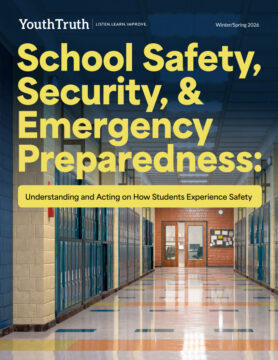
A sense of safety and security is foundational to students’ learning, belonging, and healthy development. Yet creating and maintaining schools where students feel truly safe is a complex and ever-shifting challenge, spanning protection from violence and bullying to emotional wellbeing, and disaster preparedness. At a time when investments in school safety are growing and security products are expanding, this report offers a reminder that safety cannot simply be purchased—it requires a deep understanding of, and investment in, the daily work of tending to a healthy school culture.
Research shows that young people truly want to serve others, work across lines of difference, and feel a part of their community but frequently lack…
What happens when education reform takes place without the input or engagement of the young people who will experience its effects? Conversely, what happens when…
Bullying is a persistent problem in U.S. schools, fueling distrust and debates over punishment, transfers, and prevention. Some states are trying extreme measures—ticketing parents or suspending bullies’ licenses—while Congress considers the STOP Bullying Act to fund state prevention efforts. Most districts review policies, but few have comprehensive plans, leaving gaps that students feel firsthand. Real change requires educators, policymakers, and parents to listen to students, focus on the most vulnerable, and build school cultures where safety and belonging aren’t optional.
This resource was created to support educators and others in empowering and inspiring young people to become active, engaged citizens. This guidebook complements the YouthTruth research report, Youth Civic Empowerment: Insights from the Student Experience.
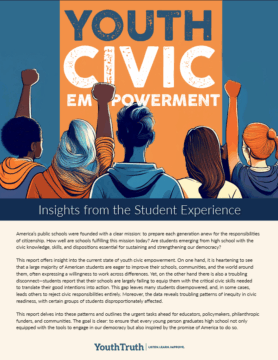
How well are public schools preparing students for civic engagement and democratic responsibilities? While many students express a strong desire to improve their communities and work across differences, there is a concerning gap: schools are often not providing the critical civic skills necessary for students to turn these intentions into action. This disconnect can lead to disempowerment or even a rejection of civic duties. Additionally, there are significant inequities in civic readiness, with some groups of students being disproportionately affected. This report calls for urgent action from educators, policymakers, funders, and communities to ensure that all students graduate with both the skills and inspiration to participate in democracy.
Mathematics is an integral part of students’ daily lives, from marking the first 100 days of elementary school to the pivotal moment of crossing the threshold into Algebra 1. Math not only serves as the key that unlocks the doors to the sciences and technology but also empowers individuals personally. At the same time, math literacy stands as an undisputed public good, providing society with the indispensable tools needed to propel innovation and grapple with intricate societal challenges.
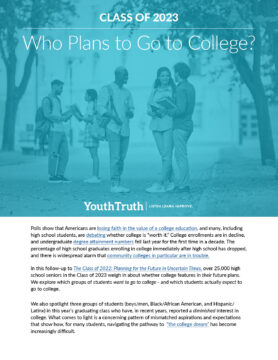
Polls show that Americans are losing faith in the value of a college education, and many, including high school students, are debating whether college is “worth it.” College enrollments are in decline, and undergraduate degree attainment numbers fell last year for the first time in a decade. The percentage of high school graduates enrolling in college immediately after high school has dropped, and there is widespread alarm that community colleges in particular are in trouble.
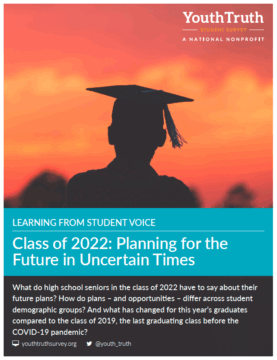
What do high school seniors in the class of 2022 have to say about their future plans? How do plans – and opportunities – differ across student demographic groups? And what changed for 2022 graduates compared to the class of 2019, the last graduating class before the COVID-19 pandemic?
This site uses third parties to host functionality and monitor the functioning and activity of the website. By clicking “continue” and navigating through this website you consent to the collection of, and disclosure to third parties, data related to your use of the website.